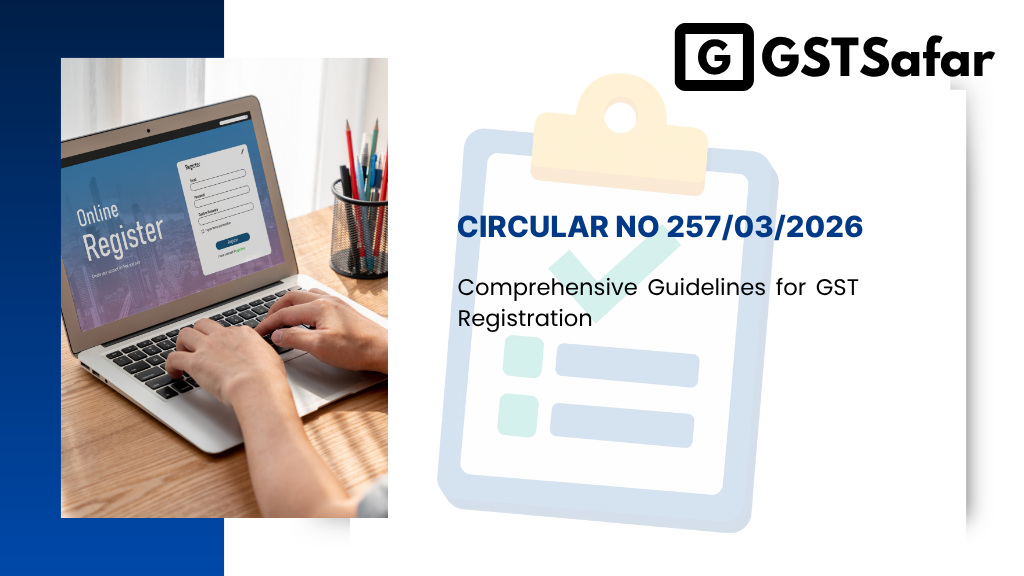
Comprehensive Guidelines for GST Registration – Circular No 257/03/2026
- The Central Board of Indirect Taxes and Customs (CBIC), through Circular No. 257/03/2026-GST dated 26.10.2026, has issued detailed guidelines under Section 168(1) of the CGST Act, 2017, to make the GST registration process simpler, faster, more transparent and uniform across India.
- The Circular provides clarity on the information and documents required for GST registration, acceptable address proofs, registration timelines, Aadhaar authentication, physical verification, handling of clarification notices and responsibilities of GST officers.
- The objective is to ensure that genuine businesses obtain GST registration without unnecessary delays, repeated queries or demands for additional documents, while preventing fraudulent registrations and misuse of Input Tax Credit (ITC).
1 GST Registration – Who Is Required to Apply?
A person is required to obtain GST registration when the aggregate annual turnover exceeds the prescribed threshold or where mandatory registration is applicable irrespective of turnover.
| Category | General turnover threshold |
| Persons exclusively supplying goods | ₹40 lakh |
| Persons supplying services or both goods and services | ₹20 lakh |
| Exclusive goods suppliers in applicable special category States | ₹20 lakh |
| Services suppliers in applicable special category States | ₹10 lakh
|
Applicants must verify the applicable registration threshold for their respective State or Union Territory.
1.1 Compulsory registration irrespective of turnover:
The Circular’s FAQs cover persons making inter-State taxable supplies, casual taxable persons, persons liable under reverse charge or Section 9(5), non-resident taxable persons, TDS deductors, agents supplying on behalf of taxable persons, Input Service Distributors, specified suppliers through e-commerce operators, e-commerce operators liable to collect TCS, overseas OIDAR suppliers to specified recipients in India and other notified categories, subject to applicable exemptions.
Persons exclusively supplying ice cream and other edible ice, pan masala, or goods falling under Chapter 24 (tobacco and manufactured tobacco substitutes) are also specifically addressed.Taxpayers below the applicable threshold may obtain voluntary registration.
2. GST Registration Forms Applicable to Different Taxpayers
| Type of Applicant | Form |
| Normal taxpayer, Input Service Distributor and Casual Taxable Person | GST REG-01
|
| Tax Deductor under Section 51 and Tax Collector under Section 52 | GST REG-07
|
| Non-Resident Taxable Person
| GST REG-09
|
| Overseas OIDAR supplier / Online Money Gaming supplier | GST REG-10
|
| UN Bodies, Embassies and other specified persons seeking UIN | GST REG-13 |
The GST portal provides different applicant categories, including Taxpayer, Tax Deductor, Tax Collector (e-Commerce), GST Practitioner, Non-Resident Taxable Person, United Nation Body, Consulate or Embassy of a Foreign Country, Other Notified Person and Non-Resident Online Services Provider and/or Non-Resident Online Money Gaming Supplier
How to apply: Visit GST Portal → Services → Registration → New Registration.
FORM GST REG-01 contains two parts:
- Part A: Basic details for generation of Temporary Reference Number (TRN).
- Part B: Detailed information regarding the business, promoters, authorised signatories, business premises, bank accounts, goods/services and other applicable particulars.
3. Important Instructions for Filling FORM GST REG-01
Part A – Basic Details :
Applicants must ensure that:
- PAN and legal name are entered correctly.
- Legal name matches the name appearing in PAN records and, for incorporated companies, the MCA incorporation certificate.
- For proprietorship concerns, the proprietor’s name is entered as the legal name.
- State/Union Territory and district of the Principal Place of Business are correctly selected.
- Where available, the email address and mobile number linked with PAN may be used.
Part B – Basic Details :
- Applicants must correctly select their constitution of business, such as Proprietorship, Partnership, LLP, HUF, Company, Trust, Society, Association of Persons, Local Authority or Public Sector Undertaking.
- Supporting constitutional documents must be uploaded as applicable, such as the partnership deed, registration/incorporation certificate, proof of constitution or HUF Karta document.
Special categories:
- SEZ Unit/Developer: Select the relevant option as “Yes” and provide the SEZ name, approval order number and date, validity period, designation of approving authority and a copy of the approval.
- Composition Scheme: Select “Yes” and the correct eligibility category under “Category of Registered Person”.
- Casual Taxable Person / Rule 14A: Select “Yes” against the relevant option where applicable.
- Reason for Registration: Correctly specify the reason, such as exceeding turnover threshold, voluntary registration, change in business constitution, inter-State supply or liability under reverse charge.
The reason selected should be consistent with the business constitution and other application details. This information may also be relevant for determining the registration category, tax liability and cancellation.
4. Details of Proprietors, Partners, Directors and Other Promoters
The applicant must provide details of the relevant persons based on the constitution of the business.
| Business constitution | Persons whose details are required |
| Proprietorship | Proprietor |
| Partnership / LLP | Managing Partner and all other Partners |
| HUF | Karta |
| Company | Managing Director and all Whole-time Directors |
| Association / Body of Individuals | Members of the Managing Committee |
| Trust | All Members of the Board of Trustees |
- The required particulars include name, father’s name, date of birth, mobile number, email address, gender, PAN, Aadhaar number (where available), DIN (where applicable), residential address and designation/status.
- DIN is mandatory for company directors and designated partners of LLPs wherever applicable. DIN and CIN information is validated electronically through MCA.
- Photograph requirements: The applicant must upload recent colour photographs of the applicable persons, including:
- Proprietor in a proprietorship.
- Partners, including managing/authorised/designated partners, limited to ten photographs where the firm has more than ten partners.
- Karta of an HUF.
- Managing Director or authorised person of a company.
- Managing Trustee of a trust.
- Managing Committee members, including Chairman, limited to ten where membership exceeds ten.
- CEO or equivalent officer of a local authority/statutory body.
- Person in charge in other cases.
- Photographs must clearly show the full front face, be individual photographs rather than group photographs and have sufficient resolution.
- Photographs cropped from PAN cards, Aadhaar cards, driving licences, passports or other identity documents should not be uploaded. Incorrect photographs may lead to clarification notices or rejection.
- Changes in promoter, partner, director, trustee or Karta details after registration can be updated through FORM GST REG-14.
5. Authorised Signatory and Authorised Representative
Authorised Signatory
The application can include up to ten authorised signatories, including the primary authorised signatory. For each signatory, the relevant personal information, contact details, PAN, Aadhaar (where available), DIN (where applicable), residential address, designation and recent photograph must be provided. An authorisation letter from the proprietor, partners, board, trust or management committee, as applicable, must be uploaded. The primary authorised signatory is required to digitally sign the registration application. The FAQs advise appointing at least two signatories, including an alternate, to support continuity. Any person who is not a minor may be appointed as authorised signatory. For a Non-Resident Taxable Person applying through REG-09, the authorised signatory must additionally be an Indian national.
Authorised Representative
Where an authorised representative is appointed :
- If the representative is an enrolled GST Practitioner under Section 48, the GST Practitioner Enrolment ID must be provided.
- For other authorised representatives, details such as name, designation, mobile number, email address and PAN must be furnished.
6. Principal Place of Business (PPoB) – Address Requirements
- Applicants must provide a complete, accurate and identifiable address of the Principal Place of Business.
- This includes the applicable building/flat/shop/plot number, Khasra/Khata number, road/street, locality, village/town/city, taluka/block, district, PIN code and nearby landmarks.
- The Circular also advises furnishing accurate latitude and longitude, wherever possible, by adjusting the location marker on the map available on the GST portal.
- Important: Mentioning only a road, locality, village or Khasra number without identifying the exact premises may result in a clarification notice or an adverse physical verification report.
- The address entered in the application must match the documentary address proof.
- Applicants must also select the correct Centre and State jurisdiction, provide proper contact details and specify the nature of business carried out at the premises, such as manufacturing, wholesale, retail, supply of services, warehouse or depot.
7. Documents Required as Proof of Business Premises
The Circular provides specific documentary requirements based on the nature of possession of the premises.
| Nature of premises | Documents required |
| Owned premises | Any one: latest property tax receipt, Municipal Khata, property identification document, latest electricity bill or latest water bill in applicant’s name |
| Registered rent/lease agreement | Valid registered rent/lease agreement |
| Unregistered rent/lease agreement, where registration is not mandatory | Rent/lease agreement and any one prescribed address proof in landlord’s name |
| Rent/lease agreement unavailable | Undertaking in prescribed Annexure-V format and relevant proof of possession/address |
| Consent basis | Consent letter in Annexure-VI format and prescribed address proof in the owner’s name
|
| Co-working space | Membership agreement specifying allocated space, together with the applicable ownership or lease documents |
| SEZ Unit/Developer | Valid Letter of Approval/Permission issued by the SEZ Development Commissioner |
| Inherited premises in deceased ancestor’s name | Death certificate, prescribed affidavit and applicable address proof |
Important clarifications for business premises
A. Property owned by family members, partners or directors
Where the property belongs to a parent, spouse, sibling, partner or director rather than the applicant, the applicant should not select “Own”. The correct option should be “Consent”, “Rented/Leased” or “Shared”, depending on the actual arrangement. Where the premises are used on a consent basis, a consent letter on plain paper must identify the owner, applicant, premises and their relationship. Consent from all co-owners is required for premises provided on consent basis.
B. Jointly owned premises
If an applicant is a joint owner and uses the premises for GST registration, separate consent/NOC from the other co-owners is not required. Where utility bills are in only one co-owner’s name, a document showing the joint ownership of the applicant and other co-owner should be provided.
C. Rent/lease agreement
- Where registration of the rent/lease agreement is legally mandatory under the relevant State/Regional law, a registered agreement must be uploaded.
- Where an unregistered agreement is permissible, the agreement and prescribed landlord’s address proof are required.
- If the electricity/water connection is in the tenant-applicant’s name, the latest corresponding bill and valid rent agreement may be furnished instead of landlord’s address proof.
D. Premises without rent agreement
The prescribed undertaking under Annexure-V must confirm lawful possession and use of the premises, supported by the applicable address/possession document.
E. Co-working spaces
The membership agreement must identify the allotted desk, cabin, suite or other clearly designated space, period of agreement and whether the service provider owns or leases the premises. If owned by the co-working provider, the provider’s prescribed ownership/address proof is required. If leased, the registered rent/lease agreement between the owner and the co-working provider is required along with the membership agreement.
F. Inherited property
Where ownership remains in the name of a deceased ancestor, the applicant must provide the death certificate, affidavit in Annexure-IV and applicable address proof. The affidavit must be executed on non-judicial stamp paper of at least ₹100, before the specified Magistrate or Notary Public.
G. Other important clarifications
- A residential address in a different city, district or State is not a ground for objection.
- A Post Office Box or courier address cannot replace a verifiable physical business address.
- Where multiple branches exist in the same building, one may be declared PPoB and others APoB, or separate registrations may be obtained subject to applicable rules. Separate address proof is required for each declared premises.
- Photographs of applicants or landlords at the premises are not prescribed as proof of business premises.
- An Udyam/MSME certificate is neither required nor acceptable as PPoB/APoB proof.
- All uploaded documents must be clear, complete, readable and consistent with the address declared.
8. Additional Place of Business and State-Specific Details
Applicants must furnish details of all Additional Places of Business (APoB) within the State of registration, wherever applicable. The documentation requirements for APoB and for amendment of PPoB/APoB details are the same as those prescribed for the Principal Place of Business. Unmanned telecommunication towers and bank ATMs are not required to be declared as PPoB or APoB.
Special requirement in certain States: For Maharashtra, Rajasthan, Odisha, Andhra Pradesh, Assam and Madhya Pradesh, information regarding the electricity connection of PPoB is mandatory, including the name of the electricity board/unit and consumer account or electricity consumer number. Applicants must also correctly provide any other State-specific information and supporting documents required by the portal.
9. Bank Account Details – Important Compliance
Under Rule 10A of the CGST Rules, bank account details are not mandatory at the time of initial registration application. However, registered persons must furnish their bank account particulars:
Within 30 days from the date of grant of registration, or before furnishing outward supply details in GSTR-1/IFF, whichever is earlier.
The following particulars must be provided:
- Bank account number and type of account.
- Name of bank, IFSC code and branch address.
- Supporting bank statement, first page of passbook or cancelled cheque containing the relevant account details.
Bank accounts must be in the name of the applicant/business and linked to the relevant PAN. Applicants may provide details of up to ten bank accounts, and all business bank accounts must be added or updated, including those opened after obtaining GST registration.
10. Goods and Services – HSN/SAC Details
Applicants are advised to provide accurate details of all goods and services supplied or proposed to be supplied by their business. Where all goods or services cannot be included, the most prominent goods/services should be selected. The descriptions should correspond to the actual business activities. HSN/SAC details may subsequently be added or amended by filing FORM GST REG-14.
11. Simplified GST Registration under Rule 14A
The optional simplified registration scheme introduced with effect from 1 November 2025 allows eligible small businesses to obtain GST registration through a faster process.
Conditions for opting under Rule 14A
- Application must be filed in FORM GST REG-01.
- Applicant must opt for Aadhaar authentication.
- Applicant must select registration under Rule 14A and agree to the applicable conditions.
- Total tax on outward taxable supplies made to registered recipients must not exceed ₹2.5 lakh in a month.
- Only one registration under Rule 14A is permitted in a State/Union Territory on the same PAN.
- Eligible applicants can receive system-generated registration within 3 working days, without officer intervention.
Withdrawal from the simplified scheme
Where a taxpayer wishes to move from Rule 14A to normal registration:
- At least one tax-period return must have been filed after obtaining registration.
- All returns due up to the date of withdrawal application must be filed.
- Application for withdrawal must be made in FORM GST REG-32.
- Documents prescribed for REG-01 must be submitted.
- The application is processed following the normal registration procedure.
After approval, the taxpayer becomes a regular taxpayer and is no longer subject to Rule 14A restrictions.
12. Registration Processing Timelines
The Circular clarifies the following timelines under Rules 9, 9A and 14A.
| Situation | Prescribed timeline |
| Automatic registration under Rule 9A | 3 working days |
| Simplified registration under Rule 14A | 3 working days |
| Normal registration with successful Aadhaar authentication, where physical verification is not required | 7 working days |
| Cases involving physical verification | 30 days |
| Reply by applicant to REG-03 | 7 working days from receipt |
| Decision after receipt of REG-04 reply | 7 working days |
These timelines are subject to the relevant statutory procedures, including application completeness, verification and clarification requirements.
13. Aadhaar Authentication, Biometric Verification and Physical Verification
Applicants are encouraged to complete Aadhaar authentication to facilitate faster processing. Where the system identifies an applicant for biometric-based Aadhaar authentication, the applicant may be required to visit a designated Facilitation Centre/GST Suvidha Kendra for:
- Biometric Aadhaar authentication.
- Photograph capture.
- Verification of original documents uploaded with the application.
The FAQs specify that the applicant must complete this process within 15 days from receipt of the TRN on the registered mobile number and email address. Failure may prevent further processing of the application.
Where Aadhaar authentication is not opted for, the applicant must visit the designated Facilitation Centre for photograph capture and verification of original documents.
When can physical verification be conducted?
Physical verification may be required where:
- Aadhaar authentication is not opted for or is unsuccessful.
- The GST portal identifies the application based on risk parameters and data analysis.
- The proper officer considers physical verification necessary after obtaining the prescribed approval.
The physical verification must be undertaken as per Rules 9 and 25 of the CGST Rules. The verification officer must upload the physical verification report in FORM GST REG-30, along with the relevant photographs and documents, at least five days before expiry of the prescribed 30-day period.
The report must clearly indicate whether the business premises exist. Where the premises cannot be located, the efforts made to locate them must be recorded. GPS-enabled site photographs and other relevant documents must be uploaded. Where the application is assigned to an incorrect jurisdiction, it must be promptly reassigned to the appropriate officer.
14. Clarification Notices – Restrictions on GST Officers
The Circular provides specific instructions regarding when GST officers may seek clarification or additional documents.
A notice in FORM GST REG-03 may be issued where:
- Documents submitted are incomplete or unclear.
- Address details in the application do not match the uploaded documents.
- Uploaded documents do not appear to be valid address proof.
- The business address is incomplete, vague or insufficient to identify the premises.
Where physical verification is not involved, the notice is to be issued within seven working days from application submission. In cases involving physical verification, the Circular prescribes the relevant 30-day period for issuing such notice.
Documents and objections that should not be demanded unnecessarily. CBIC has specifically directed officers to avoid unwarranted or presumptive queries, including:
- Demanding an Udyam/MSME certificate.
- Objecting merely because the applicant or authorised person’s residential address is in a different city or State.
- Objecting to the type of business proposed to be conducted from the declared premises without an appropriate basis.
- Making subjective assessments about whether residential premises are suitable for business.
- Raising objections merely because an electricity connection is domestic rather than commercial.
- Scrutinising electricity bill amounts unnecessarily.
Officers must restrict their document verification to the prescribed requirements. For electricity bills, water bills and property tax receipts, verification should primarily concern the name and address. For rent/lease agreements, verification should mainly concern the document’s validity, the names of the applicant and lessor, and the correct premises address.
Where documents are incorrect, incomplete or inconsistent, the officer must issue a clarification notice through FORM GST REG-03 rather than directly reject the application without providing the prescribed opportunity to rectify.
15. Reply to Clarification Notice and Registration Rejection
Where the applicant receives FORM GST REG-03:
- The applicant must submit the reply in FORM GST REG-04 within seven working days of receiving the notice.
- The officer must examine the clarification and supporting documents.
- The officer must approve the application within seven working days of receiving a satisfactory reply.
If the reply is not satisfactory, the officer may reject the application through FORM GST REG-05 within seven working days, after recording reasons in writing.
Where the applicant fails to reply within the prescribed period, the application may also be rejected. If an application is rejected, the applicant may file a fresh application after rectifying the deficiencies mentioned in the rejection order.
Deemed approval
Where the proper officer fails to take action within the applicable time limit prescribed under Rule 9, the application shall be deemed approved, and the registration certificate in FORM GST REG-06 shall become available through the GST portal.
16. Earlier Suspended or Cancelled GST Registration
Where an applicant previously held GST registration on the same PAN that was suspended under Rule 21A(2) or 21A(2A), or cancelled under Rule 22, the applicant must ensure that:
- All due GST returns relating to such suspended/cancelled registration have been filed.
- Final return in FORM GSTR-10 has been filed wherever applicable.
- No liability remains pending against the concerned registration.
17. Additional Clarifications for Applicants
The FAQs also clarify that:
Multiple registrations in one State: Separate GST registrations may be obtained for multiple places of business or branches in the same State/Union Territory, provided the person is not registered as a composition taxpayer.
SEZ registration: An SEZ Unit or SEZ Developer must obtain a separate GST registration even where another GST registration exists outside the SEZ in the same State/Union Territory. The SEZ unit cannot be covered under the existing non-SEZ GSTIN.
Bank accounts: Up to ten business bank accounts can be furnished. Details of accounts opened after registration must also be updated.
Business changes: Changes in details of promoters, directors, partners or trustees, and additions/amendments to goods or services, may be made through FORM GST REG-14.
Registration procedure: GST registration is an online and faceless process, except where physical verification, biometric authentication, photograph capture or original document verification is required.
All official communications and clarification notices must be issued through the GST common portal. Applicants should regularly monitor the portal and respond within the prescribed time.
18. Grievance Redressal for Registration Delays
Where an applicant faces unnecessary delays or unwarranted queries during registration processing, a complaint may be filed with the jurisdictional Chief Commissioner of Central Tax or Commissioner of State Tax. Such complaints may be submitted through the special email address identified by the respective GST Zone or State for this purpose. CBIC has also requested issuance of suitable trade notices to publicise the guidelines, and implementation difficulties may be reported to the Board.
19. Annexures Issued with the Circular
| Annexure | Particulars |
| Annexure-I | 51 Frequently Asked Questions covering GST registration requirements and procedures |
| Annexure-II | Checklist of documents based on constitution of business |
| Annexure-III | Prescribed documents for proof of Principal Place of Business |
| Annexure-IV | Affidavit format for premises inherited from a deceased ancestor |
| Annexure-V | Undertaking format where no formal rent/lease agreement is available |
| Annexure-VI | Consent letter format for use of premises for GST registration |
Important points from Annexure-II
The checklist specifies the applicable authorised persons, persons required to digitally sign the application and documents for proprietorships, partnerships, LLPs, foreign LLPs, HUFs, private/public/unlimited companies, foreign companies registered in India, one-person companies, societies, trusts, government departments, PSUs, local authorities and statutory bodies.
Documents include PAN, applicable constitution documents, photographs, authorisation forms, bank account details and address proof, depending on the type of applicant.
Standard formats under Annexures IV, V and VI
- Annexure-IV – Affidavit for inherited property: Covers the applicant’s identity, legal-heir status, deceased ancestor’s details, ownership and possession of premises, business use, responsibility for utility payments and GST liabilities, declaration and verification.
- Annexure-V – Undertaking where no rent agreement exists: Covers the applicant’s identity, business details, premises address, owner’s name, absence of a formal rent agreement, period of lawful possession, utility-payment responsibilities, statutory and GST compliance responsibilities and confirmation of correctness
- Annexure-VI – Consent letter: Covers the owner’s identity, applicant’s details, their relationship, full premises address, description of the specifically allocated space (where applicable), permission to carry on business, consent for PPoB/APoB registration and owner’s PAN, contact information and signature.
- Applicants should use the respective prescribed formats given in the Circular rather than relying on informal declarations.